
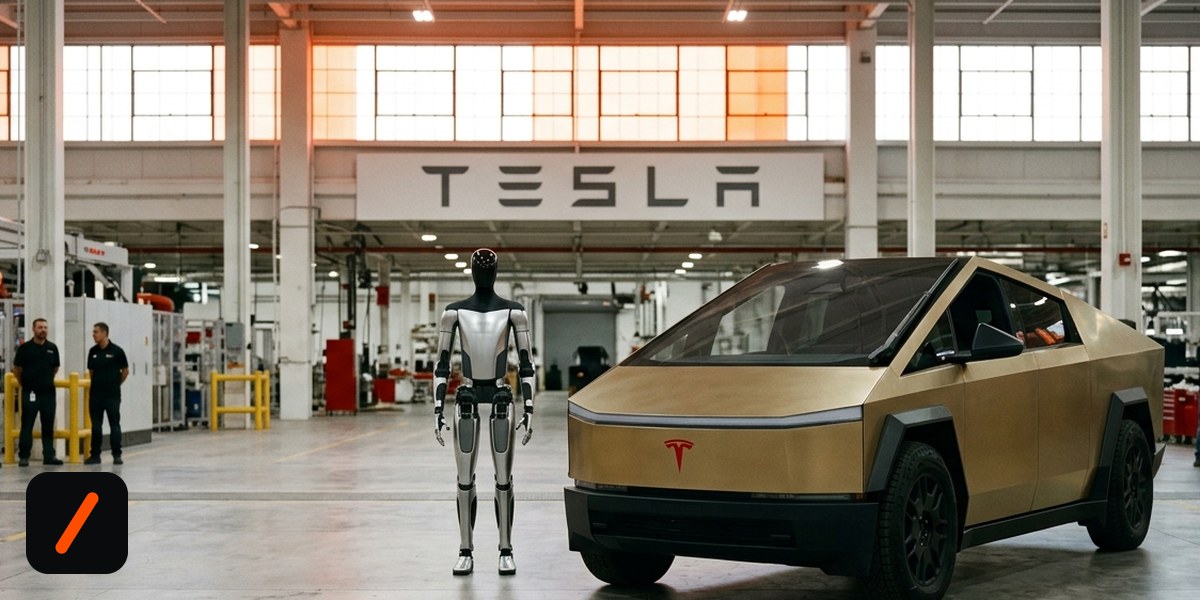
Tesla has arranged $30 billion in new credit lines, and it says it does not plan to touch any of it in 2026. That is the tell: this is a liquidity backstop, not a borrowing spree, but a company does not line up a cushion this size unless the spending ahead of it is enormous.
- $30.0B across three senior unsecured facilities, expandable by another $4B, disclosed in an 8-K dated September 29, 2026.
- Nothing is drawn. Tesla does not currently plan to borrow under the facilities in 2026.
- The biggest piece, a $20B delayed-draw term loan, can only be drawn for the first 18 months and shrinks on a schedule. That shape shows when Tesla thinks it might need money.
- Capex is running at more than double last year's pace, and analysts expect negative free cash flow of about $9.78B for 2026.
What exactly did Tesla sign?
Three senior unsecured facilities, per the 8-K. The $20B three-year delayed-draw term loan has Citibank as administrative agent. The $8B five-year revolver and the $2B 364-day revolver both have Wells Fargo as agent. The revolver can be drawn in dollars, sterling or euros and carries a $500M letter-of-credit sublimit. The whole package can be expanded by $4B.
RelatedTesla and SpaceX Commit $16.8B to Terafab Chip Plant in Texas
Pricing floats. Dollar borrowings bear interest at Term SOFR or an alternate base rate plus a margin tied to Tesla's credit rating, with SONIA for sterling and EURIBOR for euros. Commitment and ticking fees are also rating-based and paid quarterly. Proceeds go to general corporate purposes.
It replaces the $5B revolving credit agreement from January 20, 2023, which Citibank also ran. That older facility was terminated the same day with no early termination penalties. So the real change is not that Tesla got a credit line. It is that the line went from $5B to $30B.
Why does a delayed-draw loan reveal the timing?
A revolver is a general-purpose cushion. A delayed-draw term loan is more specific: the borrower can pull the money down in chunks, up to 10 times, but only during a fixed window. Here that window is the first 18 months. Undrawn commitments then fall to $10B at the first anniversary and $5B after 15 months.
Lenders price and structure a facility around when they expect it to be used. Tesla wants the $20B sitting there through roughly March 2028, and it accepts that the unused portion gets smaller along the way. Our reading: the company sees its heaviest funding pressure inside the next year and a half, and would rather pay fees on a commitment it may never use than go shopping for debt mid-build.
- Sep 29, 2026Facilities signed, old $5B revolver terminatedNo loans outstanding. No draw planned in 2026.
- Sep 28, 2027$2B 364-day revolver maturesOptional one-year term-out.
- Sep 29, 2027Term loan commitments step down to $10BFirst anniversary.
- After 15 monthsUndrawn commitments step down to $5BRoughly late 2027.
- After 18 monthsDraw window on the term loan closesUp to 10 draws allowed until then.
- Sep 29, 2029$20B term loan maturesThree-year tenor.
- Sep 29, 2031$8B revolver terminatesTwo optional one-year extensions.
Why does Tesla need this much?
Because the spending is about to change shape. Tesla expects capital expenditures in excess of $25 billion in 2026. In the first half it spent $8.28B, against $3.89B in the first half of 2025. Q1 alone was $2.49B versus $1.49B a year earlier. If the full-year guidance holds, the back half of 2026 has to be much heavier than the front.
The money is aimed at scaling the Cybercab robotaxi, the Optimus humanoid robot and Tesla Semi, with new production facilities kept separate from the existing car lines. It also covers AI compute and charging and service expansion. Regulators are watching one of them closely: see our coverage of the NHTSA probe into Cybercab. Tesla's chip ambitions are a separate cost line too, as in the Terafab plant with SpaceX, and the demand side is still forming, as in Nevada's robotaxi approvals.
If Tesla has over $40B in cash, why borrow at all?
Reporting says Tesla already holds more than $40 billion in cash, which is exactly why it is not planning to draw. The facilities are insurance. The covenant package is light: restrictions on liens and on debt at restricted subsidiaries, plus a minimum of $5B in consolidated liquidity. Next to a $40B cash pile, a $5B floor is not a constraint anyone is worried about today.
RelatedNew York Orders First US Data Center Moratorium
But cash and free cash flow tell different stories. With analysts projecting about $9.78B of negative free cash flow for 2026, the $40B is a stock that is being drawn down even if the credit lines stay untouched. A committed facility means Tesla can keep building through a bad quarter, a market freeze or a rating wobble without renegotiating from weakness.
What it means for the stock
For TSLA holders the headline is not dilution. Undrawn, unsecured bank lines do not create new shares, and no loans are outstanding. The exposure runs through three channels. First, cash burn: negative free cash flow in 2026 puts more weight on whether the robotaxi and robot programs pay off on the timeline the spending implies. Second, credit: pricing on these facilities floats with Tesla's rating, so a rating move changes the cost of carrying and using them. Third, the core business still has to fund itself. Q3 2026 delivery consensus sits at 461,974 vehicles, per TeslaNorth, and the car business is what generates the cash that the new programs consume.
Watch whether capex tracks toward the 2026 guidance, whether the first draw arrives inside the 18-month window, and whether cash holds above the level that makes the covenant floor irrelevant.
Our take
The $30 billion is less interesting as a number than as a schedule. A company that expected to borrow soon would have drawn. A company with no expected need would not bother with a 10-draw term loan that steps down on a calendar. Tesla chose the middle path: a large, cheap-to-hold option on money it thinks it might want once the new plants ramp. It shows confidence in credit access and how capital-hungry the pivot has become. If the first draw comes before the window closes in early 2028, the robotaxi and robot build-out is costing more, or earning less, than planned.
- First draw. Any borrowing before the 2026 year-end would contradict the stated plan.
- Capex pace. Whether the back half of 2026 heads toward the more than $25B guidance.
- Step-downs. Whether Tesla negotiates changes before commitments shrink to $10B and then $5B.
- Free cash flow. Whether the $9.78B analyst estimate of negative cash flow proves too light or too heavy.
- FilingTesla Form 8-K, September 29, 2026 facility terms, agents, maturities and covenants
- MarketsYahoo Finance capex figures and free cash flow projection
- CoverageTeslaNorth Q3 delivery consensus
Original analysis by GenZTech. Source: Tesla Form 8-K.